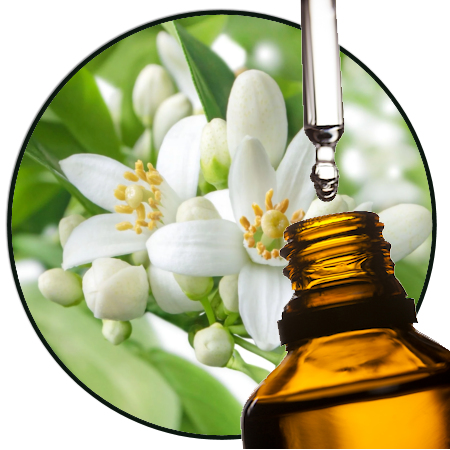
Neroli / Orange Blossom Egypt EO
Neroli from Egypt is known for its bright, floral character with a subtle green undertone. Ideal for perfumers seeking an elegant, natural heart note with emotional depth.
Botanical name : Citrus aurantium L. ssp. amara
Plant part : White blossoms of the bitter orange tree
Aroma : Sweet, floral, honeyed, luxurious
Fragrance intensity : deep, round, sensual
Extraction method : Steam distillation
Origin : Egypt
CAS number : 8016-38-4
Fragrance group: Floral
Fragrance strength : Medium (±116 hours on fragrance strip)
Powerful yet delicate bittersweet floral scent with citrus, green and slightly spicy nuances. Exotic and slightly animalic in the undertone.
1st Class Quality Products
All fragrances are selected with care
Delivery from stock
We supply everything from our own stock, unless otherwise stated on the product itself.
Neroli essential oil (Citrus aurantium ssp. amara) is one of the most refined and beloved ingredients in perfumery, especially for its floral, citrusy and slightly green character .
Fragrance Profile & Perfume Technical Use
Characteristic Description Fragrance note Heart note – forms the emotional center of the fragrance Fragrance group Floral / Citrus / Green Fragrance strength Medium to strong – lasts ±116 hours on scent strip Scent experience Elegant, sunny, bittersweet, with a calming undertone Combinations Bergamot, jasmine, rose, lavender, petitgrain, sandalwood Application in Perfume Types
- Luxury Perfumes : Neroli from Egypt is often used in high-end perfumes for its depth and complexity
- Eau de cologne : Classic citrus heart, often combined with bergamot and lemon
- Wellness fragrances : Ideal for relaxing blends due to its calming effect
- Bridal perfumes : Traditionally used for its soothing and romantic character
Neroli is not just a fragrance – it is an emotional heart note that exudes serenity, elegance and sensuality. Perfect for perfumers looking for a natural floral note with character.
| Substance name | Concentration (%) | Fragrance profile / Property |
|---|---|---|
| Linalool | 43.7–54.3% | Fresh, floral, calming |
| (þ)-Limonene | 6.0–10.2% | Citrusy, uplifting |
| Linalyl acetate | 3.5–8.6% | Sweet, soft, relaxing |
| (E)-β-Ocimene | 4.6–5.8% | Green, fruity, volatile |
| α-Terpineol | 3.9–5.8% | Fresh, antibacterial, slightly floral |
| β-Pinene | 3.5–5.3% | Fresh, woody, tonic |
| Geranyl acetate | 3.4–4.1% | Sweet, rosy, elegant |
| (E)-Nerolidol | 1.3–4.0% | Soft, fixative, skin caring |
| Geraniol | 2.8–3.6% | Sweet, rosy, skin-friendly |
| (E,E)-Farnesol | 1.6–3.2% | Warm, floral, fixative |
| Neryl acetate | 1.7–2.1% | Fresh, floral, citrusy |
| β-Myrcene | 1.4–2.1% | Spicy, balsamic, slightly fruity |
| Sabineen | 0.4–1.6% | Spicy, tonic, stimulating |
| Nerol | 1.1–1.3% | Sweet, fresh, skin-friendly |
| (Z)-β-Ocimene | 0.7–1.0% | Green, volatile, fruity |
IFRA Compliance Advice – Neroli Essential Oil
| IFRA category | Application type | Max. usage percentage |
|---|---|---|
| Category 1 | Lip products, children's toys | 2.62% |
| Category 2 | Deodorants, body sprays | 0.77% |
| Category 3 | Eye products, face makeup, cleansers | 15.00% |
| Category 4 | Perfumes, eau de toilette | 15.00% |
| Category 5A–D | Creams, lotions, leave-on products | 3.62% |
| Category 6 | Oral care | 3.20% |
| Category 7A–B | Rinse-off products (shampoo, shower gel) | 15.60% |
| Category 8 | Baby products | 1.50% |
| Category 9 | Rinse-off household products | 28.75% |
| Category 10A | Leave-on household products | 22.00% |
| Category 10B | Not limited | — |
| Category 11A–B | Air fresheners, sprays | 5.20% |
| Category 12 | Non-skin contact (paper, textiles, etc.) | Not limited |
Substances with IFRA limits in Neroli oil
| Dust | CAS number | Concentration (%) |
|---|---|---|
| Farnesol | 4602-84-0 | 8.00% |
| Geraniol | 106-24-1 | 5.00% |
| Citral | 5392-40-5 | 0.20% |
| Citronellol | 106-22-9 | 0.20% |
| Benzaldehyde | 100-52-7 | 0.10% |
| Carvone | 99-49-0 | 0.10% |
These guidelines are intended to ensure the safe use of fragrances in various product categories.
For commercial applications it is important to adhere to these percentages and, if necessary, have a CPSR (Cosmetic Product Safety Report) drawn up.