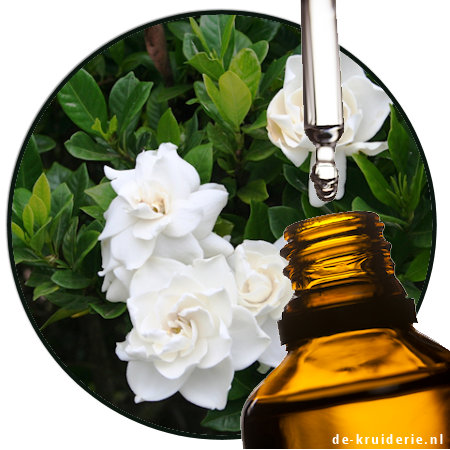
Gardenia is known for its warm, deep, slightly sweet and hypnotic aroma.
The fragrance is similar to jasmine but has more creamy, richer notes and a rounder body.
Gardenia is a fragrance that can be used on its own as a perfume (diluted, of course) because the scent is
in balance.
Gardenia is often used in luxury women’s perfumes and blends well with neroli (orange blossom), rose otto, tuberose, citrus scents, ylang ylang, clove bud, cinnamon leaf, among others.
Gardenia essential oil is also used in aromatherapy and is used for such things as
insomnia, anxiety, stress, headaches, nervous tension and various skin conditions.
A few drops in an aroma burner or adding to a bath or liquid soap works fine.
Because of its warm strong fragrance, Gardenia is liked to be used in potpourris.
Technical note:
Gardenia is not a true essential oil because the flowers cannot be steam distilled.
This product is an organic extraction, similar to an absolute but thinly liquid and easy to handle.
Therefore, it is listed both at Absolutes & Extracts as well as Essential Oils for optimal findability.
After organic extraction, vacuum distillation is used to purify the extract and make it thinly liquid for easier processing.
* Footnote:
Vacuum distillation is a purification step that takes place after the organic extraction of a floral material such as Gardenia, Narcissus, Lilacs or Osmanthus.
After the fragrances are first extracted from the flowers with a mild solvent, the extract is gently heated under reduced pressure (vacuum).
Due to the lower pressure, unwanted components – such as solvent residues, waxy compounds or heavy byproducts – evaporate at a much lower temperature than normal.
This prevents scent damage and provides a cleaner, more stable and often thin liquid end product.
So vacuum distillation does not change the way the fragrance is extracted, but refines the extract so that it is easier to incorporate into perfumes.